

Reflections on the ALPSP 2026 Redux Conference with Grace Balfour-Harle
Written by 28 April 2026
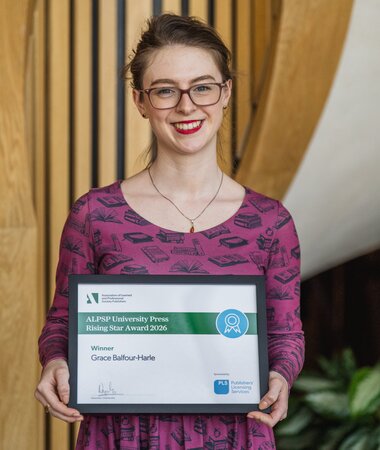
ALPSP University Press Rising Star Award Winner, Grace Balfour-Harle, Edinburgh University Press, looks back at the Redux Conference.
I was lucky enough to go along to ALSPS Redux Conference 2026 on the 17th and 18th March, hosted by Liverpool University Press. I had a couple of really interesting and inspiring days, and have broken down my learnings and takeaways into common themes, in both content and messaging.
Collaboration
Academic publishing is a collaboration between the author and the publisher – one cannot exist without the other. ‘What do ECRs Want from Publishers?’ explored collaboration by considering the unique academic landscape ECRs find themselves in. A single-authored monograph is still the ‘gold standard’ for contracts and output measuring, especially in humanities and social sciences, meaning the pressure to publish is high. However, proposals, lack of industry knowledge and funds, and predatory publishers make navigating publishing a minefield, leading to knowledge-sharing through the ECR Network by the British Academy, providing training, resources, and above all, community, for ECRs, by ECRs. Takeaways for publishers included clear guidance on their website for proposals and the publishing process, regular communication at all stages, with deadlines communicated early.
However, academic publishing is not just a collaboration between a press and an author – it is a collaboration within a vast ecosystem. So the ‘University Library Trends and Priorities’ plenary was both thought-provoking and inspiring, as university libraries in the main are our direct connection with readers. Students’ needs from a library are changing: skills labs, resources, community space, and digital-first collections available at a touch of a button, so libraries’ needs are changing too. Readers want more accessible content, across multiple
platforms and devices immediately, and have declining print use. As a result, libraries are downsizing their print collections, leading to collaborative collections and resource sharing within libraries, Interlibrary Loans, and direct collaboration with associated university presses. Being a ‘safe place for students to fail’, community and communal spaces, and getting creative in using their declining or stagnant library budgets, for libraries, unique collaborations and community are key, and university presses must adapt their offerings to reflect this.
Trust
Another common theme at Redux: trust. Trust in the systems within academia (peer review, production processes, Open Access systems), and the unique trust academics have in university presses and mission-led publishing. Wendy Queen spoke about trusting our infrastructure in ‘The Necessary Transformation of University Presses’, and if something is built into the infrastructure (e.g. sustainability and accessibility) throughout the workflow and workplace, its output can be trusted. ‘Sustainability on a Shoestring’ and ‘Accessibility’ touched on this, where metadata and discoverability were king: the most accessible or sustainable product is nothing if it isn’t discoverable. So by building them into our infrastructure, we can trust and develop our workflows accordingly.
It also leaves us room to be flexible and adapt as new technologies develop – like AI. Wendy Queen implored university presses to design their infrastructure for machine-mediated scholarship as ‘we can’t stop scholars from using it, but we can adapt and grow with it. Not acting is no longer neutral, so we must build transformation into the infrastructure, and trust in it.’ George Walkley built on this theme of trust and AI – positing that trust in human-created knowledge may become more valuable as more machine-created ‘slop’ floods the market, giving university presses a unique position as trusted purveyors of this knowledge.
Change and Transformation
I paraphrase Dennis Lloyd, director of Wisconsin Press: ‘Change is the only constant in life, and in scholarly publishing’, from the ‘Publishing in Polarising Times’ panel, which was unsurprisingly a common theme at Redux this year. As Wendy Queen mentioned, not changing is not neutral anymore, the landscape is moving too quickly for us to wait it out and see where it ends. She spoke about both transformation and innovation, and while often used interchangeably, they are not always synonyms: ‘Transformation is a disciplined redesign of structure so our scholarly values follow wherever it goes.’ AI capabilities are increasing by the day and we need to be actors in our own fate, or our systems won’t be able to cope. George Walkley described the four main scenarios he foresees for publishing as a result of AI, linking how knowledge is discovered and how it is produced, and where academic publishers sit within these scenarios. His slides and notes are available here.
We need to change with the times, but as an industry, we can be slow to move on these developments, for fear of doing it ‘wrong’ or imperfectly. John Sheer spoke passionately in his ‘Toxic Perfectionism’ panel about creating a workplace that empowers staff, despite the constant pressure for ‘perfect’ print projects from both presses and academia. Technological changes, harsh economic environments, the diminishment of humanities and print books, the decline of tenure and rise in adjunctification in academia are all factors that build the pressure within the industry to be ‘perfect’, and all that comes along with it. He reminded us that ‘good enough’ is good enough, and encouraged us to step back to consider whether the ‘perfect print’ model always serves our authors and readers.
Progress over perfectionism continued in the ‘Sustainability on a Shoestring’ panel, where it is better to start small than not at all. If you aim for perfectionism with sustainability, where the goalposts are constantly moving, you’ll never get started. Recommendations from the panellists came in many forms: from thinking in a ‘system approach’ to building your carbon footprint data to inform sustainability goals; small shifts having a big impact and celebrating these; and to consider how publishing economics, sustainability and accessibility can go hand-in-hand. Put simply, accessibility is a ‘win-win’ morally and economically. By providing empowerment for all readers, the wider the dissemination of a university press’s work. Having a dedicated accessibility contact, transparency on accessibility procedures, building into the workflow metadata filtering through the supply chain, and using new technologies to go beyond the legal accessibility standard were the biggest takeaways. And by doing so as sustainably as possible, we are doing our bit to ensure the future of the industry on an inhabitable planet.
From the ‘University Library Trends and Priorities’ panel, it is clear that the reader of tomorrow prioritises digital over a printed product, and the ‘New Horizons in Digital Publishing’ panel explored the digital. Allison Levy spoke about multimodal monographs and born-digital products being developed at Brown University, and the flexibility they present in the ways researchers can present their work. Nicola Wilson spoke about digital archiving and the challenges and possibilities for the Archive of British Printing and Publishing. Kim Williams spoke about Princeton University Press’s digital offering and how to strategise and build your own digital list with four Ds of Digitisation: ‘Define. Digitise. Diversify. Discover’.
Consistency
Despite these constant landscape-altering changes happening, for academic presses, publishing high-quality and innovative research is still the mission. Disseminating knowledge through print production is still the gold standard, and isn’t going away anytime soon. ECRs are still pushing for their first printed monograph, the sustainability and economic viability in wholly digital products compared with print can be called into question, and sometimes a physical book is the most accessible form a publisher can provide. While university presses will need to adapt to this changing landscape, our mission hasn’t changed, and by staying this course, we can build and maintain our place as trusted publishers of high-quality knowledge.
