

Lean Editorial: Doing More with Less in Research Integrity
25 August 2026
Research integrity has a signal problem — there are simply too many signals. Signals have become a commodity. The real bottleneck now is the workflow that surrounds them.
As the technology provider for one of the major platforms in research integrity, and systems integrator for a lot of publishers, Appetence sits at the center of the research integrity (RI) field. We do not build screening tools ourselves; instead, we develop the enabling infrastructure used by a large number of publishers. That position gives us visibility into the full breadth of how RI signals are produced, shared, and acted on.
The market is crowded with screening tools, and the range is expanding rapidly. Each tool produces its own stream of RI signals and data, and those signals vary widely in how they should be interpreted and how reliable they are. The result is that publishers are overwhelmed. RI teams face enormous workflow challenges simply because of the sheer volume, and that volume only grows as more tools and more signals come online. In practice, signals end up being deprioritized or ignored altogether - not because they lack value, but because there is no realistic way to process them all.
A further challenge is translation. Journal editors are not equipped to interpret “raw” RI data, yet research integrity teams are constantly working to turn screening outputs into clear, actionable recommendations towards editorial teams. At its heart, the RI workflow is a hand-over: the research integrity team interprets the signals, and the journal editor makes the editorial decision. Getting that hand-over right - turning noisy data into a concrete next step - is what separates a process that scales from one that quietly collapses under its own weight.
We saw the same picture confirmed in the field. During the London Book Fair in March 2026, a survey of publishers revealed that tackling research integrity at scale is one of their biggest challenges right now. At the same time, many of those same publishers see real opportunity in integrating AI into their existing workflows.
This is exactly where our solution focuses, on the workflow inside a publisher's research integrity team. On the input side are submissions and their associated RI signals from one or more screening tools. The workflow itself involves interpreting that signal data, analyzing the submission further where needed (including viewing the actual document), and finally handing the case to the editor who makes the editorial decision. Each of those steps is manual today, and each one is a place where good signals get lost.
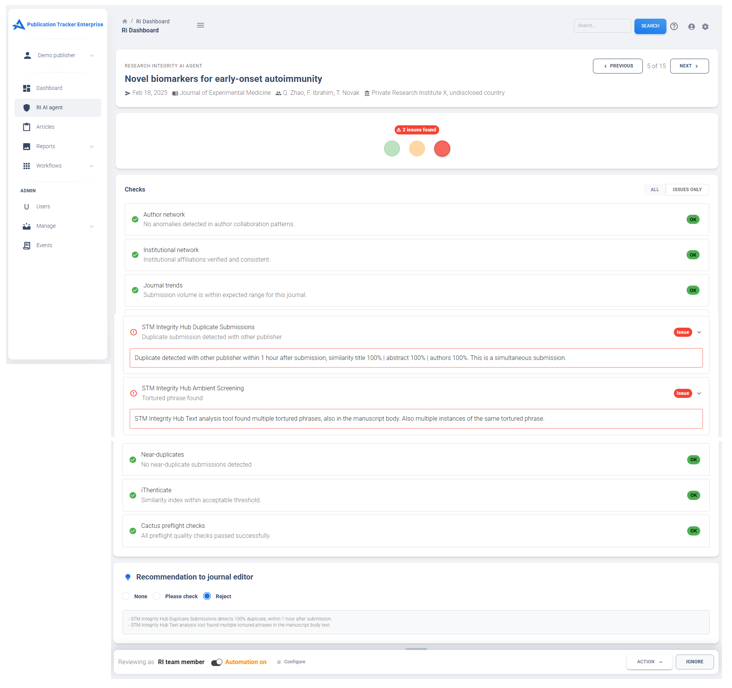 On top of that, we are developing an AI agent that can take over these manual steps. Put simply, it learns from previous cases and always operates under full control, with a human in the loop. The AI agent can perform each step automatically and unattended: it decides when further analysis is warranted, pulls up other relevant information, interprets the content, and turns everything into a clear recommendation for the editor - so the team's scarce attention goes to the decisions that genuinely need a human.
For publishers, research integrity is one of the biggest operational challenges at scale, and that is precisely where our AI agent is aimed. Get the fundamentals right, and AI genuinely accelerates workflows, drives efficiency, and reduces costs. In 2026, deploying an AI agent is no longer the hard part. The real challenge is getting the foundations right - specifically, the grounding mechanism that ensures the agent works accurately and reliably, every time, so that editors can trust its recommendations. That is where we are concentrating our effort, and it is what we will be bringing to the ALPSP annual conference in Manchester: a number of new solutions that show where AI genuinely adds value, and how it can reset expectations around research integrity screening.
About the author
 Ivo Verbeek is the director of Appetence. Ivo co-founded his first IT company in 1999. In its second year, Elsevier became one of its clients. Over the years, Ivo worked on various projects, such as CiteAlert, a contract management system, and several e-commerce sites, including the Elsevier webshop. The work evolved into author services, leading to the launch of Peerwith in 2015. With the rise of AI, language editing no longer had a future, and Peerwith came to an end. Ivo returned to IT services and co-founded Appetence. Shortly afterwards, contracts were secured to become the technology partner for the OA Switchboard and, more recently, for the STM Integrity Hub.
As a leading systems integrator in STM Publishing Appetence connects publishers to shared open infrastructure, implement simple workflows, improve interoperability of systems and store high quality metadata in a central place to accommodate reporting across all your systems.
